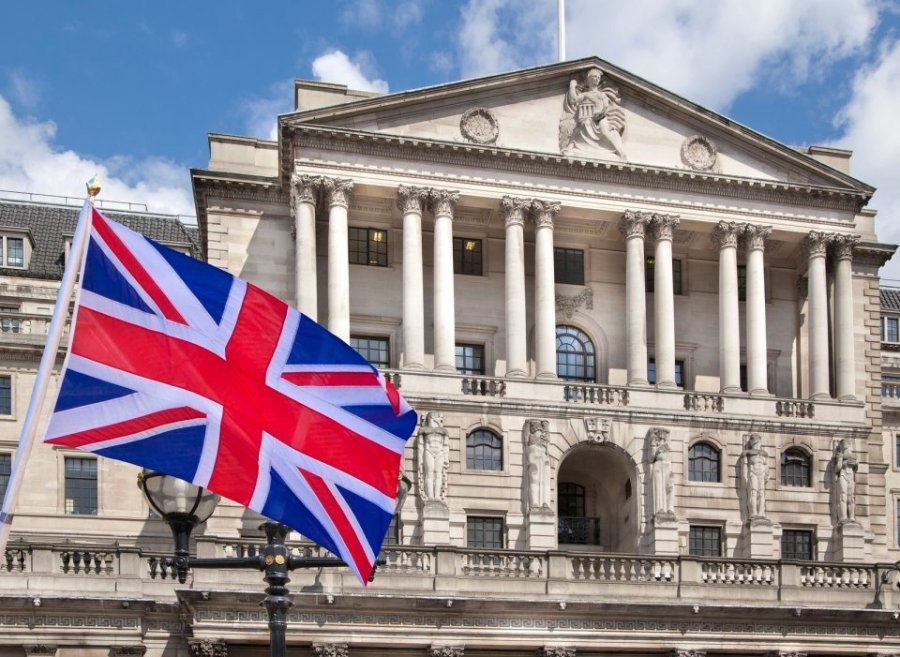
We continue publications about the banks of the world and the history of banking
July 27, 1694
Founding of the Bank of England
The Bank of England began as a private bank that was supposed to act as a banker for the government. It was founded primarily to finance military action against France. The King and Queen of the time, William and Mary, were two of the original shareholders.
The original Royal Charter of 1694, signed by King William and Queen Mary, explained that the bank was founded to "promote the public good and welfare of our people."
In fact, this document is still used in the Bank's modern mission of England:
“To promote the welfare of the people of the United Kingdom by maintaining monetary and financial stability.”
The Bank of England began its work on 1 August 1694 in temporary premises at "the Mercers' Hall" in Cheapside. He had only 17 clerks and two gatekeepers.
1694
Sir John Houblon becomes the first Governor of the Bank of England
The early years of the Bank of England's leadership by Sir John Houblon focused on the urgent financial demands of the government and the issue of new coinage. The bank also began to engage in regular banking activities, accepting deposits from the public.
From 1994 to 2014, Sir John Houblon was featured on the £50 note.
1720
The South Sea Bubble: The first financial crisis in the history of the Bank of England
In 1711, "the South Sea Company" was founded. Threatening the Bank's position as the government's banker and owner of the national debt, the South Sea Company traded loans to the government for trading rights in the Spanish-controlled South Seas (now known as South America). At this time, Britain was at war with Spain.
Trade was minimal, but the South Sea Company set its sights on servicing the national debt, which at that time was the main task of the Bank of England.
In 1720, the South Sea Company was transferred to part of the national debt, and the price of its shares rose sharply. This caused a rush of investment in its shares, but then prices fell sharply, and thousands of people were ruined..
1725
Issuance of the first denomination banknotes
Before 1725, banknotes were written by hand, often for a specific amount deposited by the client. In 1725, the Bank of England began issuing partially printed notes for amounts of £20 upwards, in increments of £10. The highest face value was £90. However, each face value could be increased by a maximum of £9 19 shillings 11 pence (£9.99) to reflect the actual amount deposited. The cashier increased the denomination of the note by hand.
1734
The Bank of England moves to Threadneedle Street
In 1734 the Bank of England moved to a site on Threadneedle Street, where it remains to this day. Gradually, over the next 100 years or so, the Bank bought up surrounding areas until it owned the entire 3.5-acre site in central London.
The first architect to create the first purpose-built bank building in Britain was George Sampson. The building was said to be in the Palladian style, characterized by symmetry and classical design.
The Bank's payment to the contractors for the remainder of the new building in 1734 was £268, 17 shillings and two pence.
October 1788
Appointment of architect Sir John Soane ("Sir John") Soane")
One of Britain's greatest architects began his 45-year career at the Bank of England. He expanded the Bank, doubling its area to 3.5 acres, and surrounded it with a windowless wall in 1828.
Soane's architecture for the Bank of England complex remained virtually intact until it was demolished and a new building erected by the architect "Sir Herbert Baker" between 1925 and 1939. However, the outer wall, built by Sir John, remains in place to this day.
Minutes of meetings held by Sir John Soane and photographs of the plans are part of the Bank of England archives.
1797
The Prohibition Period
In 1797, France declared war on Britain. When a small French army landed on the British mainland, fears of capture quickly spread. At this time the public rushed to the Bank of England to exchange their notes for gold, which was possible then.. The amount of gold held by the Bank fell from 16 million pounds to just 2 million pounds.
To try to preserve the already depleted gold reserves, Prime Minister William Pitt the Younger (“William Pitt the Younger”) issued a Privy Council Order requiring the Bank of England to stop paying gold for banknotes.
A famous cartoon shows William Pitt the Younger trying to "seduce" and extract gold from the old lady representing the Bank of England. This was an attempt to help finance the coming war with France.
From this date, the Bank of England became known as the "Old Lady of Threadneedle Street".
1797-1821
Counterfeits during the Restriction Period
During the Restriction Period (1797-1821), the Bank of England's obligation to exchange notes for an equivalent amount of gold was temporarily suspended cancelled. This was caused by a shortage of gold due to the over-printing of banknotes.
This period created conditions favorable to counterfeiting as the Bank of England issued low denomination notes (1 pound and 2 pound) for the first time to compensate for the shortage of gold coins. These notes were used by people unaccustomed to paper currency and often illiterate. They became easy prey for counterfeiters.
Counterfeiting Bank of England notes was considered a serious crime, and more than 300 people were hanged during this period. The Bank of England's archives contain many correspondence with prisoners from Freshfields Prison who were detained on charges of counterfeiting.
Before the Prohibition period, counterfeiters were more likely to try to alter notes already in circulation rather than print new ones. One example was the attempt to turn a 10-pound note into a 20-pound note by "doubling" its value.
1826
The first Bank of England branch opens
Branches of the Bank of England were first established in 1826 in response to the financial crisis of 1825-1826, which led to the bankruptcy of many countries and provincial banks.
One of the main reasons for the creation of bank branches was to provide additional control over the circulation of banknotes in order to prevent a new crisis.
The first branch of the Bank of England was opened in Gloucester on July 19, 1826.. However, this branch was one of the shortest-lived, as it never generated significant profits. In 1849 the business was transferred to a branch in Bristol.
1834
The Bank of England opened a branch in Plymouth
As Bank of England branches opened throughout the United Kingdom, they began to adapt to the economic conditions of different regions.
The Royal Navy requested the opening of a branch to assist with banking needs and provide easy access to banknotes This was one of the reasons why the Plymouth branch was opened in 1834.
The Plymouth branch closed in 1949.
1844
Bank Charter Act
The Bank Charter Act 1844 gave the Bank of England a number of new powers and formally regulated the issue banknotes in Great Britain. This Act of Parliament placed restrictions on all banks, companies or persons in England and Wales that issued their own banknotes, and stopped granting new banks the right to issue banknotes throughout the UK.
9-10 May 1866
Overend Gurney Financial Crisis
There have been many financial crises in the history of the Bank of England. One of the most famous in Great Britain is the Overend Gurney crisis of 1866.
Overend Gurney was the largest discount house of its time. Although it was a profitable business, over time it accumulated large amounts of bad loans. When the company attempted to extend the lines of credit on these loans, Overend Gurney suffered significant losses. This ultimately led to its demise, and it suspended payments on May 10, 1866.
On May 9, 1866, the Bank of England received an appeal for help from Overend Gurney. The bank refused assistance, citing the broker's insolvency.
The failure of Overend Gurney and subsequent events sparked a fierce policy debate that helped define the Bank of England as "a lender of last resort" for many years to come.
1870
Signing of notes by "Chief Cashier"
C The Bank of England had a Chief Cashier since 1694, and his role has always been key to the issue of banknotes.
In 1870, the Chief Cashier (then "George Forbes") became the sole signer of Bank of England banknotes... This tradition continues and all banknotes printed and issued by the Bank of England bear the signature of the current Chief Cashier.
1894
First woman to be officially employed by the Bank of England
In 1894, Miss Janet Hogarth became the first woman to be officially registered as an employee of the Bank of England. Janet was appointed as the first Superintendent of Ladies Clerks and her salary was £157.10.0 - a very good salary for the time. Six years earlier she had received her first degree from Oxford University.
Janet then hired "Miss Elsee", a Cambridge history graduate, as her assistant at an annual salary of £105. The two soon began leading a group of women involved in sorting and counting banknotes. A record of their appointment can be seen on pages 79–82 of the Court of Directors' Minutes of 1894.
1908
Bank of England Sports Center opens at Roehampton
In 1908, the same year as the London Olympics, the Bank of England opened a sports center for its staff in Roehampton. It was located adjacent to the Bank's archives center and was created to encourage cooperation and understanding between staff of all ages and levels of management. Office space was also provided, including an archive.
The clubhouse was destroyed by an incendiary bomb in November 1940, and a new pavilion was built between 1955 and 1956. In December 1995 the club opened to local residents to cover the rising costs of running the centre.
1914-1918
First World War
On 10 August 1914, the minutes of the Directors of the Bank of England announced that the Chief Executive had "granted leave on full pay to as many clerks as possible who could be released for service in the Defense Forces country."
Seventy-one Bank of England employees died during the First World War. Today, these employees, as well as those who died during the Second World War, are remembered by a memorial in the Bank's lobby and a statue in the courtyard.
The Bank of England played an important role in helping the government during the war, for example by issuing war bonds in 1914.. Although it was reported that these war bonds were oversubscribed, the public did not actually buy enough bonds to help finance the defense effort. Therefore, the Bank of England bought most of the bonds from its own reserves and hid this fact to maintain public confidence.
1920
Montagu Norman becomes Governor of the Bank of England
Montagu Norman becomes Chief Executive of the Bank England from 1920 to 1944. To this day, he is the longest serving governor of the Bank of England.
Norman played a key role in rebuilding the international monetary system after the First World War. He participated in the creation of the Bank for International Settlements and the League of Nations.
Under Norman's leadership, the Bank of England actively supported British industry. During the Second World War he made significant contributions to monetary and financial policy.
1925
Threadneedle Street rebuilt
Between 1925 and 1939, the architect of the Bank of England, Sir Herbert Baker, demolished what became known as "The old Bank". Soane's Bank. The Old Bank, designed by the architect Sir John Sowan, was considered one of London's architectural masterpieces. Sir Herbert built a new Bank of England headquarters building on the same 3.5-acre site in Threadneedle Street.
The Old Bank of England was largely no more than three stories high. The new building had seven floors above ground and three below ground to accommodate the additional staff needed to handle the Bank's rapidly growing volume of business.
1931
Gold Standard Suspended
The Gold Standard directly linked the value of British currency to gold and allowed people to exchange Bank of England notes for an equivalent amount of gold.
In September 1931, Great Britain suspended the gold standard. Confidence in the pound fell sharply, and the subsequent decline in confidence led to a massive exchange of the pound for gold, causing the Bank of England's reserves to fall significantly.
1939-1945
World War II on Threadneedle Street
During the Second World War, some Bank of England departments were evacuated to Hampshire.. However, the gold remained in London.
During the Blitz bombing, the Bank of England was fortunately not directly hit by a bomb. However, there was minor damage to the outside of the building as the road near the Royal Exchange took a direct hit.
1940s
Wartime Banknote Counterfeits
In an attempt to destabilize British currency during the war, the Nazis introduced counterfeit £5 notes into circulation in Britain. These counterfeit banknotes were printed at the Sachsenhausen concentration camp outside Berlin. The project was codenamed "Operation Bernhard".
At that time, the design of large denomination banknotes (from £5 to £1,000) had not changed for almost a century. The method of their production also remained unchanged, which led to the Germans being extremely successful at counterfeiting them.
Almost 9 million banknotes worth £134 million were printed by the Nazis - a figure exceeding 10% of the total number of banknotes in circulation in the UK. At the time, a Bank of England banknote expert described them as "the most dangerous ever seen".
Extraordinary measures were taken to slow this process, including a special blue £1 note issued in 1940, the first to use a metal thread in a note. In 1943, the Bank of England temporarily stopped issuing banknotes in denominations above £5 to deal with the threat of counterfeiting.
1946
The Bank of England is nationalized.
Throughout the history of the Bank of England, it has seen itself as a public institution acting in the national interest. Although the Bank of England had long been privately owned, the actions of the Bank of England were determined by government and legislation.
When the Bank was nationalized in 1946, this meant that it was now owned by the government rather than by private shareholders.
This gave the government the ability to appoint the chief officers and directors of the Bank, and to issue instructions to the Bank. To date, the Government has not used its ability to issue guidance.
1960
Her Majesty Queen Elizabeth II became the first monarch to appear on Bank of England banknotes..
On 17 March 1960, the Bank of England issued its first banknote featuring Her Majesty Queen Elizabeth II. Until this point, Britannia was the only character depicted on banknotes.
Since then, the Bank of England has used several images of Her Majesty Queen Elizabeth II on its banknotes, and portraits have become an important anti-counterfeiting feature. This is because people tend to notice even subtle differences in facial features, as opposed to differences in images of inanimate objects.
1960
First Quarterly Bulletin Published
The Bank of England published the first issue of its "Quarterly Bulletin" in late 1960
The first Quarterly Bulletin contained Chief Executive Cameron Cobbold's address at Mansion House, an article on the Bank's special deposit procedure, an article on private sector financial surplus, and monetary statistics of the day.
1968
First printed Giants
In 1968, the Bank of England printed its first Giants notes. With a denomination of £1 million, these notes have a different style to other banknotes and never leave the Bank of England premises. Like the Titans (£100 million), they play an important role in the value of Scottish and Northern Ireland banknotes.
9 September 1970
The Bank of England issued its first illustrated note
The £20 note, issued in 1970, featured "William Shakespeare" on the reverse, as well as the famous scene with balcony from Romeo and Juliet. This marked the beginning of a new series of banknotes (Series D), which featured historical figures on the reverse.
Portraits and highly detailed machine engraving were woven into historical scenes, making the notes more difficult to counterfeit.
The £20 note, featuring Shakespeare, was designed by "Harry Norman Eccleston", MBE Empire (MBE), the first full-time artist-designer of the Bank of England, and his assistant Roger Withington.
16 September 1992
The UK withdrew from the European Exchange Rate Mechanism (ERM)..
The European Exchange Rate Mechanism was created in 1979 to reduce exchange rate volatility and achieve monetary stability in Europe. This was seen as preparation for a monetary union that would eventually lead to a single European currency (the euro). All currencies were required to remain within two agreed rates.
The UK joined the ERM in 1990. However, following massive interest rate hikes and interventions in the foreign exchange markets that failed to move sterling off the ERM floor, the government decided to withdraw as the costs of trying to keep it within the bounds were considered too high.
The subsequent financial crash was dubbed "Black Wednesday". This was thought to have cost £3 billion to Her Majesty's Treasury.
The interest rate increase to 15% the following day was reversed and regular meetings between the Chancellor and the Governor of the Bank were arranged to assist the Chancellor on monetary policy matters.
February 1993
First inflation report published
In October In 1992, the Chancellor invited the Bank of England to "provide a regular report on progress towards achieving the Government's inflation targets". In accepting the invitation, then-Chief Robert Leigh-Pemberton said the Bank's goal would be to "produce a fully objective and comprehensive analysis of inflation trends and pressures."
The first quarterly Inflation Report was published in February 1993. It is now called the Monetary Policy Report and is still one of the main publications of the Bank of England. It is published quarterly and is accompanied by a press conference at which the Governor and Deputy Governor of Monetary Policy speak.
1994
In July 1994, the Bank of England celebrated its tercentenary.
To mark the occasion, 130 central bankers were invited to attend a symposium on the future of central banking. The symposium concluded with a session featuring "Lord Richardson", "Paul Volcker", "Jacques de Larosière" and "Karl Otto Pöhl"... It was accompanied by a variety of events, including a musical gala concert at the Barbican Center and the launch of a commemorative £2 coin issued by the Royal Mint.
The celebrations concluded with a service of thanksgiving at St Paul's Cathedral, attended by Her Majesty Queen Elizabeth II, the Prime Minister, members of the Cabinet, former heads and directors, the Lord Mayor and Mayoress of London, and representatives Westminster, Whitehall and the clergy.
October 1996
Financial Stability Review (FSR) launched
In the autumn of 1996, the Bank of England launched a new publication, the biennial Financial Stability Report (FSR). Since then, the FSR has covered developments affecting the stability of the financial system and promoted the Bank of England's current position on risk, regulation and market institutions.
The first issue discussed CREST payments, electronic money and the London Metal Exchange review.
In 2006 the title was changed to the "Financial Stability Report" to reflect the change in content and objectives.
1996 year
Start of Real Time Gross Settlement
The Bank of England has provided two or more institutions with the ability to settle without settlement risk since the mid-19th century.
In 1996, the Real Time Gross Settlement (RTGS) system was created to allow institutions, mainly banks, to settle payments in a variety of ways. Most payment systems in the UK use the Bank's RTGS system for settlements between member banks and other institutions.
On an average day, the RTGS system distributes around £775 billion between banks and other institutions.
1997
Bank of England branches opened
The Bank of England had branches throughout the country. But in 1997 they were replaced by 12 regional agencies. The former Leeds branch became a clearinghouse to help distribute banknotes across the country.
The agencies act as the Bank of England's "eyes, ears and voice" in their regions. They collect information on trends and new developments and help explain their policy decisions to businesses, industry and the workforce.
2012
Prudential Regulation Authority (PRA) and Financial Policy Committee (FPC) formed..
Following the 2007-08 financial crisis, the government decided to undertake major regulatory reform. Reforms to the financial system were introduced through the Financial Services Act (2012), which established:
- an independent Financial Policy Committee (FPC) established within the Bank of England
- a new prudential regulator, the Prudential Regulation Authority, created as a subsidiary of the Bank
- new responsibilities for the Bank of England to supervise financial market infrastructure providers.
13 September 2016
First polymer banknote issued
The Bank of England's first banknote printed on polymer - a five pound note featuring Sir Winston Churchill - was issued on this day. Polymer is a thin, flexible plastic material that lasts longer, remains cleaner and is more difficult to counterfeit than paper banknotes.
Of course, there are disproportionately more interesting facts in the history of the bank. The Bank of England has come a long way and is undoubtedly one of the oldest and has the strongest traditions.
According to История банка Англии

You May Also Like
Bank of America received a new crypto patent
Bank of America (BoA) has received a patent for remote storage of private keys and, according to the official document, this development can be used to store cryptocurrencies.
What is stopping institutional investors from investing in cryptocurrencies?
The significant lack of cryptocurrency custody services has prevented institutional investors from diversifying their portfolios to include this volatile asset class. Currently, only Coinbase and Kingdom Trust provide custodial services.
