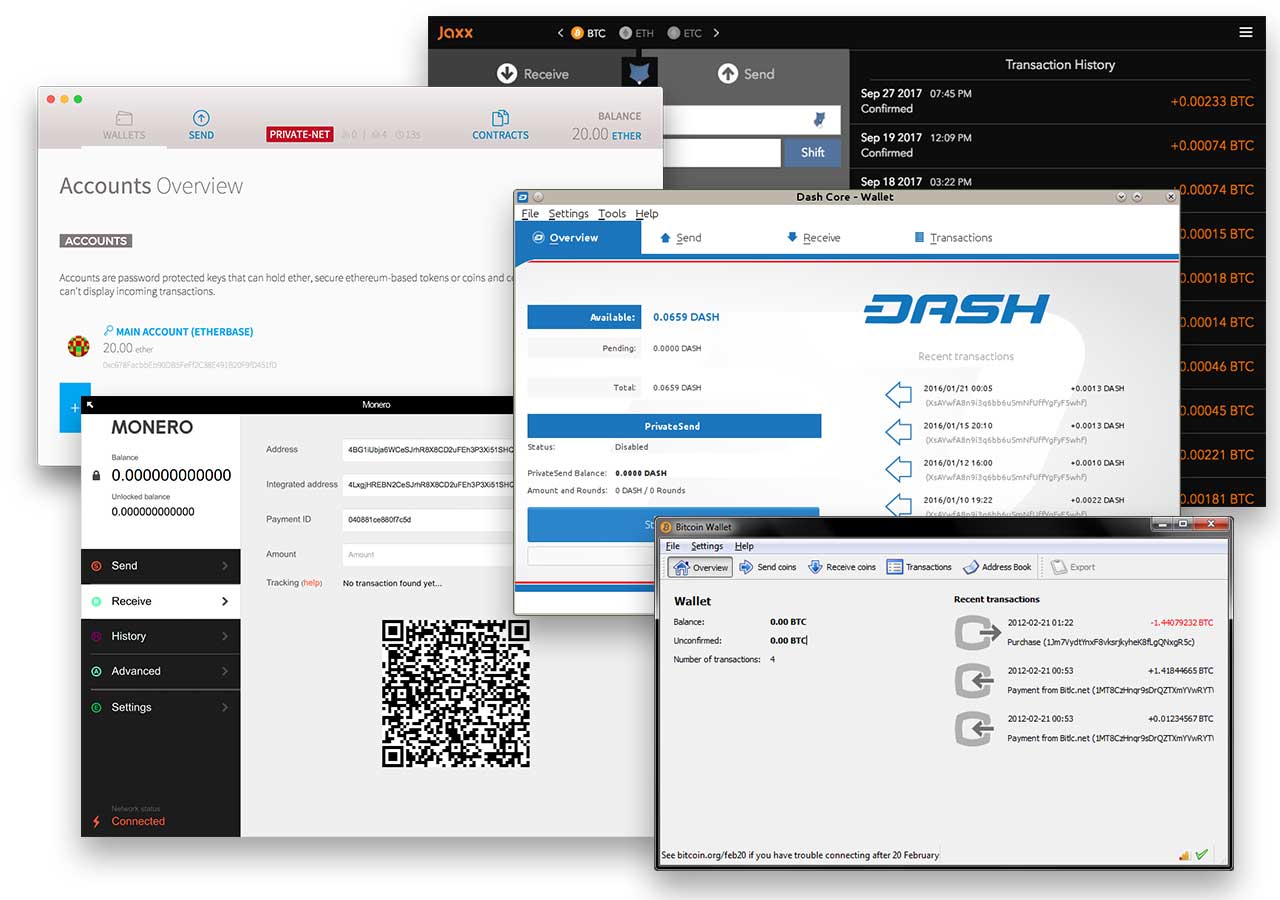
Previously, we looked at the main ways to store cryptocurrencies and manage your funds. Now we continue our series and will dwell in more detail on programs that perform the functions of a wallet.
As we said in the previous article HOW TO STORE BITCOIN? DEALING WITH WALLETSThere are several categories into which all methods of storing bitcoin and other cryptocurrencies can be roughly divided. Let us remember that these are software wallets that run on the user’s computer, online storage services, and finally hardware solutions. Today we will dwell in more detail on software wallets.
Historically, software wallets were the first, and to this day they are actively used. Moreover, the operation of most hardware wallets is impossible without a special program that runs on a personal computer or smartphone. In addition, the same online services are based on the same software systems.
The programs themselves are also quite diverse, and have different functionality, additional features and conveniences. Among them there are simple lightweight versions for mobile devices, and “Swiss knives” that support many cryptocurrencies, and individual solutions to provide additional security and anonymity.
First of all, these are complete implementations from the developers of a particular cryptocurrency themselves. As a rule, such wallets implement the basic functions stated by the creators, such as obtaining an address, checking the status of the wallet, sending funds and viewing transactions. Less often, they implement additional functions, for example, the DASH wallet allows you to start the process of “mixing” coins.
Most often, wallets from developers require downloading the complete blockchain history, and, accordingly, require quite a lot of space on the computer’s disk.
In addition to implementations from cryptocurrency developers, third-party developers are constantly developing and writing their solutions, which, in addition to basic functions, implement additional features and also support several different altcoins. A good example of such a wallet is Jaxx, a software wallet currently implemented for 8 platforms, not only Windows, Linux and MacOS X but also mobile - Android and iOS..
Among the “third-party” wallets there are implementations for different platforms, both with a graphical interface and a command line interface, wallets that implement both a full node and “thin” clients. Often software wallets, by their nature, are just an interface to an online service, or are hybrids.
Let's try to understand what is needed for the program to be considered a full-fledged wallet.
The main task of a cryptocurrency wallet is not storing “coins”, as it might seem, but storing keys and ensuring their security. This happens due to the very nature of blockchain technology. After all, virtually every machine that stores the complete history of the blockchain is also a storage facility for your coins. But the keys to them should only be in your hands.
You can obtain information about transactions from the bitcoin network or the corresponding cryptocurrency, and also view the balance. For example, you can use the so-called “block explorers” - services that allow you to view the blockchain in an understandable form. But only you should have the opportunity to spend money.
And finally, here are examples of several common wallets.
Bitcoin wallets
Program from bitcoin developers, with the longest story. Currently maintained and developed by the Bitcoin Core team. It is a basic implementation that provides basic functions - obtaining an HD address, checking status and viewing transactions. The disadvantages are that it requires downloading the full blockchain history and does not support many functions included in the Bitcoin protocol, such as multisig addresses. Available for desktop operating systems: Windows, macOS and Linux. Based on the code of this wallet, solutions for many forks are built - litecoin, DASH.
Easy to install and use. What is important is that the code is completely open and verified by a large number of developers.
- Armory
A wallet whose developers paid maximum attention to security and anonymity. Provides commission control, which allows operations to be carried out quickly in the current realities.. Like the previous one, it requires downloading the blockchain. The source code is open, but does not have such a clear pattern for releasing updates as bitcoin core has.
- Electrum
Like Armory, it provides full control of the commission. Additionally, a two-factor authentication scheme has been implemented. This provides a greater level of protection against viruses and Trojans. Electrum also does not store the entire blockchain history, but verifies transactions using a random server on the network. And this, in turn, greatly reduces the requirements for available storage space. And, as a result, there is a version not only for desktop systems, but also for Android. However, it is important to remember that when checking a transaction, you trust third parties.
You can find more wallets on the official website Bitcoin Core, their advantages and disadvantages are also described there.
Wallets for other cryptocurrencies
Standard wallet implementation for Ethereum. In addition to the basic functions for any wallet, it implements advanced features, such as managing smart contracts. Requires downloading the full blockchain, which takes quite a lot of time.
- Mist
Another implementation from the Ethereum developers, previously it was announced as the official wallet from the creators of the cryptocurrency. Hosted on the team's official git repository and continues to be supported. One of the interesting features is that it is integrated with the ShapeShift cryptocurrency exchange and allows you to exchange ether for bitcoin.
Official implementation of the wallet for DASH. Externally and programmatically it is very similar to Bitcoin-QT, in fact it is its direct successor. Requires a full blockchain to operate. Implements standard DASH functions - sending funds, checking the status of the wallet, viewing transactions, sending “instant transfers” and mixing coins.
- Jaxx
a multi-currency “harvester” that supports a list of several dozen cryptocurrencies. What’s nice is that there are versions for mobile platforms: iOS and Android.. We plan to release an extended review of this wallet with a detailed analysis of its functions and capabilities.
Of course, the listed wallets are not a complete list, these are only examples for a general understanding of what a software wallet is. And in this list we deliberately did not indicate programs that are solely an interface to online services, such as blockchain.info or XAPO.

You May Also Like
How much can a novice investor earn from trading? Part nine. Trading (continued)
We continue the series of publications about trading in order to understand in practice how much a novice investor can earn using only the forecasts published on our website. To understand how useful they are, we decided to conduct an experiment and simulate a situation in which a person who only knows about trading that he needs to “buy cheaper and sell more expensive” tries to earn additional income in his free time from work by investing part of his funds in cryptocurrency trading
How much can a novice investor earn from trading? Part 31.
We continue the series of publications about trading in order to understand in practice how much a novice investor can earn using only the forecasts published on our website. To understand how useful they are, we decided to conduct an experiment and simulate a situation in which a person who only knows about trading that he needs to “buy cheaper and sell more expensive” tries to earn additional income in his free time from work by investing part of his funds in cryptocurrency trading
