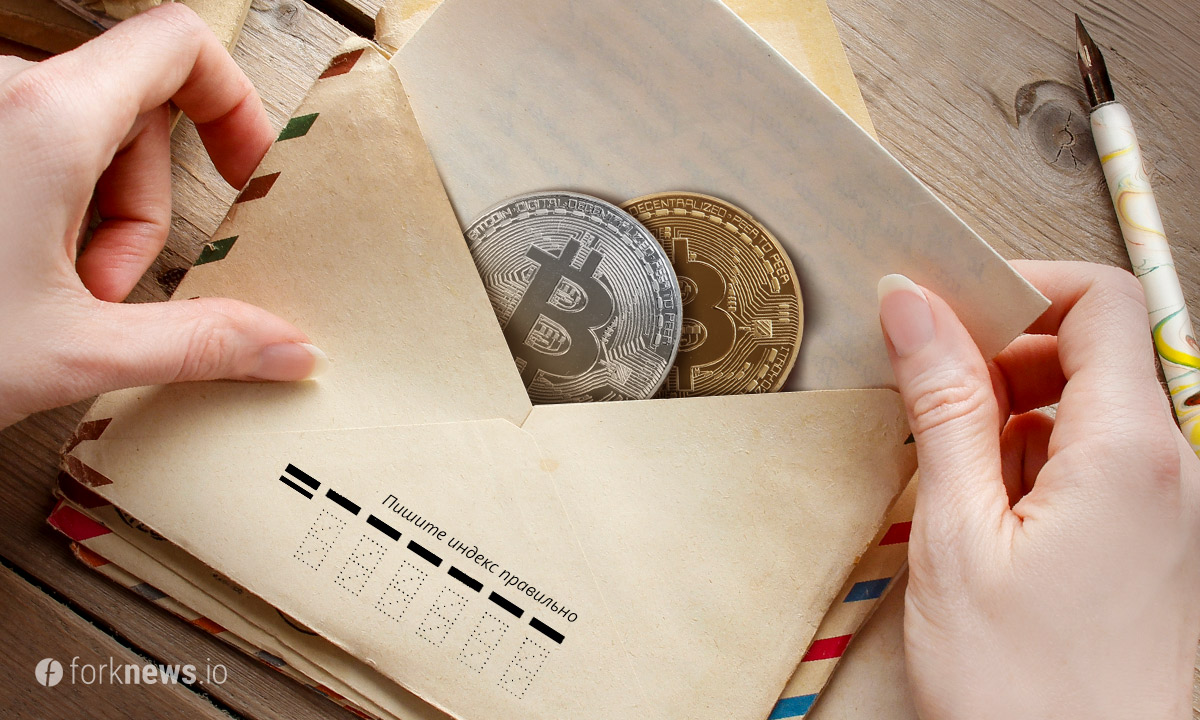
In 99% of cases, in real life you will not enter the address manually. However, knowing how an address works is useful and can sometimes save you from losing funds.
The number of cryptocurrencies today exceeds all reasonable and even unreasonable limits. And most of them are stillborn trash coins. We will look at some of the most popular and widespread representatives of the industry. And I’ll start, logically, with bitcoin, as the founder and progenitor of the genre.
When creating bitcoin, the creators paid considerable attention to the address format in order to eliminate the situation of “oh, wrong way!”. We remember that a transaction in the blockchain is not only irrevocable, but also anonymous?
As a result, a small mistake when entering an address can simply send funds “to the village of grandfather, Konstantin Fedorovich.” Moreover, this will happen in such a way that most likely no one will see these funds again.
To make the attractions of unprecedented generosity described above impossible, the address is organized very cunningly. The base58 system is used to record the address. Which, in turn, is a modified base64 system.
Base64 was born in the days of analog modems, UUCP email, and other ancient computer technologies. The problem that base64 solved was the following: most communication channels were focused on transmitting text information. And when they got into such communication channels of binary data, they became sad.
Text information meant: letters (of the Latin alphabet) from A to Z in upper and lower case, numbers from 0 to 9, punctuation marks: period, comma, quotation marks, plus, minus, and some special characters - such as space or line feed. Everything else is conventionally considered binary or binary data.
So, in order to transmit this very binary data, but not “break the Internet”, cunning programmers came up with base64 notation - a system of writing only in printed characters and numbers. 64 in this context is the 64 characters used, A-Z, a-z, 0-9. Of course, the volume of data was noticeably gaining weight, but the old systems calmly swallowed it, thinking that it was text. There were, of course, other variations, such as UU-encode, but in general the scheme was similar.
We are interested in base64, or more precisely, its variation base58.
Question - where did the 6 symbols go, and what symbols exactly? base58 excludes all characters that may be visually similar and create confusion when entered manually.. Excluded are 0 (zero), O (capital Latin o), I (capital Latin i), l (small Latin L). Also in base64 "+" (plus) and "/" (slash) were used - they were also excluded. Thus, you will never see these characters in bitcoin addresses. Here is a complete list of characters that can be used in addresses:
123456789ABCDEFGHJKLMNPQRSTUVWXYZabcdefghijkmnopqrstuvwxyz
But that's not all.
To record bitcoin addresses (and its successors litecoin, dash), the base58check option is used - the data is not just encoded into text form, but is also additionally protected from distortion. More precisely, it’s not exactly protection, but if you enter even one character incorrectly, the software will immediately determine that something is wrong with the address and will not allow you to send funds in an unknown direction.
And finally, the address contains the so-called NetID - additional information about what kind of address it is and what it is intended for. Visually, this is expressed in the fact that some bitcoin addresses begin with the symbol 1 (the so-called P2PKH addresses) and some with “3” (the so-called P2SH addresses). There are also addresses starting with "2", "m/k" - but you will only see them if you are a developer and use test networks.
Now a few words about Ethereum and their address recording.
Ether developers decided to do everything their own way, not to bother, but simply use a HEX sequence as an address. HEX is a record in hexadecimal form, that is, numbers from 0 to 9 and Latin letters A, B, C, D, E, F. This record begins with the prefix “0x”. In this case, the register has no meaning and the address:
0xc2d7cf95645d33006175b78989035c7c9061d3f9
0xC2D7CF95645D33006175B78989035C7c9061d3F9
These the addresses, from a network point of view, are identical. And when transferring funds to any of these options, the result will be the same. However, many users encounter a strange entry when part of the address is written in upper case (naturally only letters) and part in lower case.
Such an entry appeared in the EIP55 (Ethereum Improvement Protocol) standard, when the developers suddenly remembered that it would be nice to have a way to check the correctness of the transferred data, but it was too late to change the length of the address by adding a checksum to it. In this simple way, a checksum is sewn into the address, which allows you to determine whether the address was distorted during transmission or not..
So the address 0xfb6916095ca1df60bb79ce92ce3ea74c37c5d359 with checksum verification will look like this: 0xfB6916095ca1df60bB79Ce92cE3Ea74c37c5d359
Of course, such a crutch does not allow you to enter an address manually normally, but at least when transmitting the address it allows you to check its integrity.

You May Also Like
Intra-exchange arbitrage - is it possible to make money?
Last time we talked about inter-exchange arbitrage in the cryptocurrency market. Today we will touch upon intra-exchange arbitrage in more detail.
How to recognize a dummy token?
With the advent of a huge number of tokens on the crypto market, the question of choosing an investment object is becoming more and more complex. Three main criteria for a dubious cryptocurrency will help you navigate the world of altcoins.
