
Based on the order book, you can classify the players currently present on the market. Analysis of their actions will help you make the right forecast and choose your own behavior strategy.
In our previous article we touched mainly on the terminology associated with the Market Book. In the continuation of the review, we will talk in more detail about ways to identify traders whose orders are in the order book.
In order to better perceive information from the order book, it is necessary to classify the traders who place them.
Classification of players
High-frequency robots (HFT) - these transactions may not be visible in the order book, because instantly are performed, but they are clearly visible in the feed. At their core, these are bot trading algorithms, the advantage of which is the speed of their calculation.
Scalpers are traders or bots who trade on very short time periods, concluding a large number of transactions during a trading session. Scalpers take profits when trading inside the spread. Analyzing the order book, they set the best bid to buy, and immediately ask to sell. If you calculate the timing correctly, the profit from such a transaction more than pays for the commission for it.
If an offer with a large volume appears in the order book, then, as a rule, it cannot be executed immediately. Scalpers enter the market in the hope that after the closure of a large offer, the stop losses of traders who expected the price to rebound from the offer will be triggered. Automatic closing of stop loss orders gives the price an impulse, on which scalpers try to make money.
Market makers - place orders to maintain liquidity in the market and narrow the spread. Such activity is beneficial for issuers of not very liquid assets and for the exchanges themselves. These actions are quite risky for the market maker, so they use special trading algorithms with two-way quotes. And the exchange provides them with preferential commissions, allowing them to frequently make multi-directional transactions.
Investors and professional tradersare players who make transactions according to their own trading strategy. They are most often prone to panic and predictable behavior. Such players can be identified by the volume of transactions, the frequency of placing and re-submitting orders..
Large playersare investors with a large volume of assets that can seriously influence market movements. The main task of order book analysis is to identify such players and determine their goals. Determining their presence in the market is not so easy. They often disguise themselves as average investors, breaking the asset volume into smaller orders. The skills to identify them are called tape reading.
Analysis of player behavior
In the book of orders you should always pay attention to the big players. The orders they place are usually designed to implement a specific strategy to change the price in the desired direction. The most important thing here is to understand in which direction they want to move the market.
A large order does not necessarily belong to a major player. Since orders placed at the same price from several traders are combined into one line of the order book.
A large order (“Wall”), which is at the daily lows or highs, shows the level where most traders are going to close positions and at this point a price reversal will occur.
If a large order is at a support or resistance level, then it can serve as an obstacle to price movement. When trading, you can count on the fact that the price will stop when it hits the Wall, so a stop loss can be set immediately behind it. But if the Wall is an order that was placed by one large player, then it should be taken into account that when the price approaches this level, the Wall may simply disappear (this happens when a large player cancels his order). Then the price continues to move further, breaks stop losses, and only then reverses.
Iceberg is a large order, the visible part of which is in the order book, and the underwater part can only be seen in the Feed. In the order book we constantly see a large order for some exchange rate. As soon as it is executed, another application appears in its place at the same rate. This is the visible part of the Iceberg. And if you look at the Feed, we will see many already completed applications for the same course. They are considered underwater.. This is a large player breaking a huge Wall into several large orders in order to keep the price at a given exchange rate.
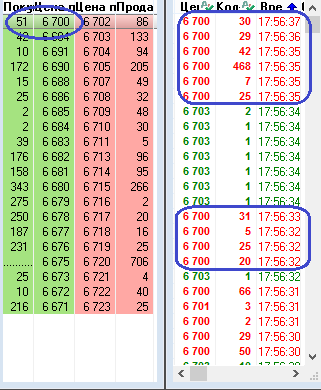
Your choice of behavior strategy depends on a correctly done analysis of the Depth of Market and an understanding of which players are currently present on the market. You can use the information obtained to predict:
- in which direction prices will move;
- where is the optimal entry point into the market;
- where is the level at which it is best to close the deal and take profit.
Happy trading!

You May Also Like
How much can a novice investor earn from trading? Part twelve. Trading (continued)
We continue the series of publications about trading in order to understand in practice how much a novice investor can earn using only the forecasts published on our website. To understand how useful they are, we decided to conduct an experiment and simulate a situation in which a person who only knows about trading that he needs to “buy cheaper and sell more expensive” tries to earn additional income in his free time from work by investing part of his funds in cryptocurrency trading.
Forks, hard forks, altcoins... Don't get confused!
More and more people are immersing themselves in the world of cryptocurrency. The world is quite complex to understand without technical training and knowledge of specific terms. To assess the situation on the market, manage investments correctly, and navigate the flow of news and ratings of cryptocurrencies, today we get acquainted with the term fork.
