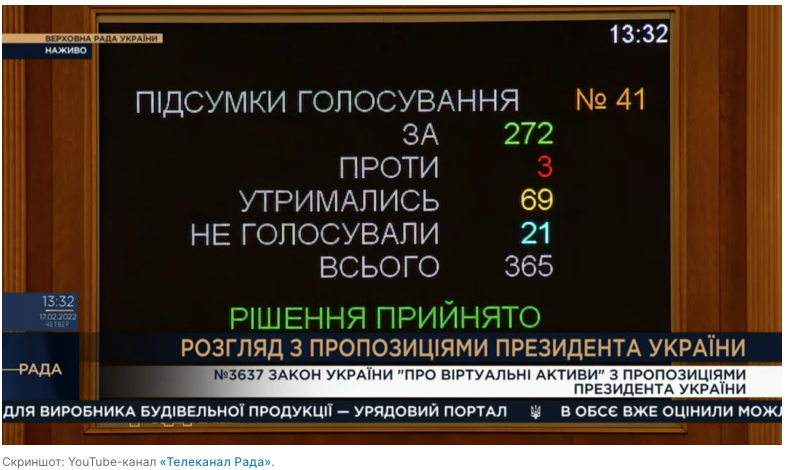
The Law “On Virtual Assets,” taking into account presidential amendments, was adopted yesterday by the Verkhovna Rada of Ukraine.
The Law “On Virtual Assets”, legalizing cryptocurrency transactions in the country was vetoedby the president in September last year. Yesterday, by an absolute majority, deputies voted to adopt the updated document with presidential amendments.
The law classifies the turnover of virtual assets as financial services and instructs two existing regulators to take them under their jurisdiction. Now, compliance with financial legislation on the Ukrainian crypto market will be monitored by the National Commission for Securities and Stock Market (NCSM) and the National Bank of Ukraine (NBU). The first version of the law proposed creating a separate department for the crypto market, but the budget does not provide funds for this.
The jurisdiction of the NBU includes virtual assets that are backed by national, foreign currency or metals. The National Commission will issue permits to operators of digital assets and should develop an accounting mechanism and a register of providers of such services in the next six months.
The National Securities and Stock Market Commission will also regulate other categories of digital assets, including derivative instruments.
The President must sign the adopted document within ten days. The law will come into force after amendments are made to the Tax Code. So far, no such proposals have been submitted to the Verkhovna Rada for consideration.
Subscribe to ForkNews on Telegram to stay up to date with news from the world of cryptocurrencies

You May Also Like
Redistribution of zones of influence on South Korean crypto exchanges
In September, the South Korean government introduced harsh measures against crypto exchanges. The “bloody massacre” led to the fact that out of several dozen sites, less than ten remained afloat. Between the survivors, something began that can be compared to the times of the 90s, through which the business of post-Soviet countries went through.
The IMF again criticized the legalization of Bitcoin in El Salvador
In the report, El Salvador: 2021 Article IV Mission Staff Final Statement, the IMF praised El Salvador's efforts to promote "financial inclusion and growth" but criticized the tool the country's government is using to achieve this goal.
