
What role do modern banks play in the financial system?
Earlier, in our reviews, we examined the evolution of the financial system from “private finance” to the international financial system. What role do banks play in this system?
In modern scientific literature, the general definition of a bankhas approximately the following form:
A bank is a legal entity that conducts financial and credit operations with financial assets (money, securities, etc.) on the basis of a license from a central or national bank to provide relevant services to government and commercial organizations, as well as the retail sector of the economy - private entrepreneurs and individuals for the purpose of making a profit.
The word “Bank” itself comes from the Italian banco - a bench, bench or table on which in ancient times money changers laid out various types of money to exchange one type for another.
As a rule, the activity of money changers did not end with a simple exchange. Later they became intermediaries for payments.
In the Middle Ages, the transfer of funds from one person to another was carried out using a double entry in a special book. This way it was possible to avoid the dangerous transportation of large amounts of money from one place to another and the labor-intensive counting of different coins.
Another type of service provided by money changers, called from the word “banco” - banchiere (bankers) is the issuance of funds at interest. At that time, this type of activity was very dangerous, because the Pope condemned the issuance of loans with interest. Those found guilty were deprived of communion and Christian burial, and all debtors were released from paying their obligations to their creditors. Such threats prompted the royal authorities to expel bankers from their lands and, under the guise of a church ban, to appropriate their property. In some lands it was possible to buy the right to engage in banking, while the payment of interest, which the church prohibited, was disguised as compensation for the costs of raising funds.
Were money changers the direct ancestors of modern banks?
Long before the medieval money changers, the ancient Egyptian temples took on the function of storing and exchanging commodity money.. Keeping records of funds and transactions with various forms of money were carried out by priests. Ancient papyri were found in which records of loans issued, real estate transactions and pawnshop transactions were kept.
In addition to Egyptian temples, transactions with property that the temple received were carried out in ancient Greece and ancient Rome. The main income of the temple consisted of income from land rent and donations. Since the property of the temple was sacred and inviolable, the temple itself enjoyed great trust. There is evidence confirming that upper-class citizens received loans against the transfer of property as collateral. Accounts of these “banking transactions” have been preserved. Along with the temples in Athens, the issuance of loans and small exchanges was carried out bytrapezitas, and in ancient Rome this was in charge ofmensaris. (Greek τραπεζαρία and Roman menso also mean “table”)
Consequently, the emergence of the first real banking institutions, although it was associated with the flourishing of the exchange activities of Italian bankers, who were later among the founders of the first bank, but in ancient times “primitive banking operations” were carried out by the priests of the ancients temples, refectories and mensari.
In the Middle Ages, from the 13th to the 14th centuries, in Italy, with the development of the feudal economy, the first full-fledged banks began to emerge that conducted commercial activities. In 1407, the bank "Compere di San Giorgio" ("Cash of St. George") was opened in Genoa, which was established by merchants and money changers ("bankers") who financed the government of the Genoese Republic. The functions of the bank, in addition to exchange, payments and acceptance of private deposits, included the collection of certain taxes to repay interest on the government loan.
In 1584, the Senate of the Venetian Republic established the first state bank, Banco della Piaza de Rialto. The state established a monopoly on banking; private individuals were prohibited from engaging in it. Later this ban was lifted.
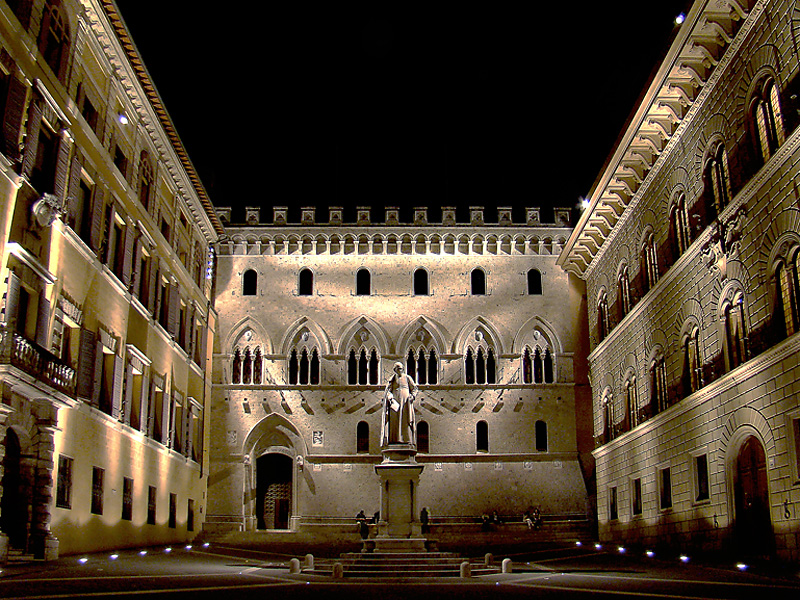
Among the first banks founded in the 15th century, there are those that have existed to this day. Among them is the Italian bank in the city of Siena “Monte dei Paschi di Siena”, which was founded in 1472. It used to be called Monte Pio, which could be translated as “mountain of money”.. In addition to exchange, the bank was involved in raising funds for issuing loans to wealthy citizens of the Republic of Siena.
The activities of banks included not only the provision of services related to monetary exchange and payments, it took on government functions of collection and storage taxes, maintaining the army, paying salaries, paying for urban construction. Thus, banking activity was essential in the functioning of the state. During this period, state financial flows began to form, and the bank was an instrument for the formation of state financial funds and their redistribution. This is how banks became subjects of the financial system.
The modern banking system is usually two-tier. A central or national bank is a government agency that controls the country's monetary policy, regulates the activities of commercial banks and ensures the functioning of the payment system. (This is the first level). At the second level there are other state and commercial banks. By the nature of their activities, they can be universal or specialized.
What do banks do and what functions do they perform?
Modern banks have retained almost all the functions that the first banks performed since their founding. Before the advent of medieval banks, their functions were performed by ancient temples, trapezites, mensars and bankers.
The main functions were:
1. Attracting and accumulating deposit funds to create investment funds;
2. Lending;
3. Movement of financial assets between entities, turnover from one form to another.
As we see, modern banks perform the same functions, only new types of financial assets and more advanced methods of accounting for them have been added. With the help of modern communication, the payment system and access to assets have evolved to such an extent that they allow transactions to be carried out at any time, almost instantly.
For the purpose of proper government control over financial flows, the entire banking system is strictly centralized and subject to strict rules that regulate banking activities.. Banks are agents of tax and exchange control.
Currently, the process of globalization of the banking system continues. With the development of scientific and technological progress, large banks maintain constant contact with global financial centers, which strengthen the processes of centralization of banks in the global financial system.

You May Also Like
Overview of the features of the REN project
The REN system allows Bitcoin to be transferred to DeFi pools, providing liquidity and over-the-counter exchange.
How much can a novice investor earn from trading? Part 24. Trading (continued)
We continue the series of publications about trading in order to understand in practice how much a novice investor can earn using only the forecasts published on our website. To understand how useful they are, we decided to conduct an experiment and simulate a situation in which a person who only knows about trading that he needs to “buy cheaper and sell more expensive” tries to earn additional income in his free time from work by investing part of his funds in cryptocurrency trading
