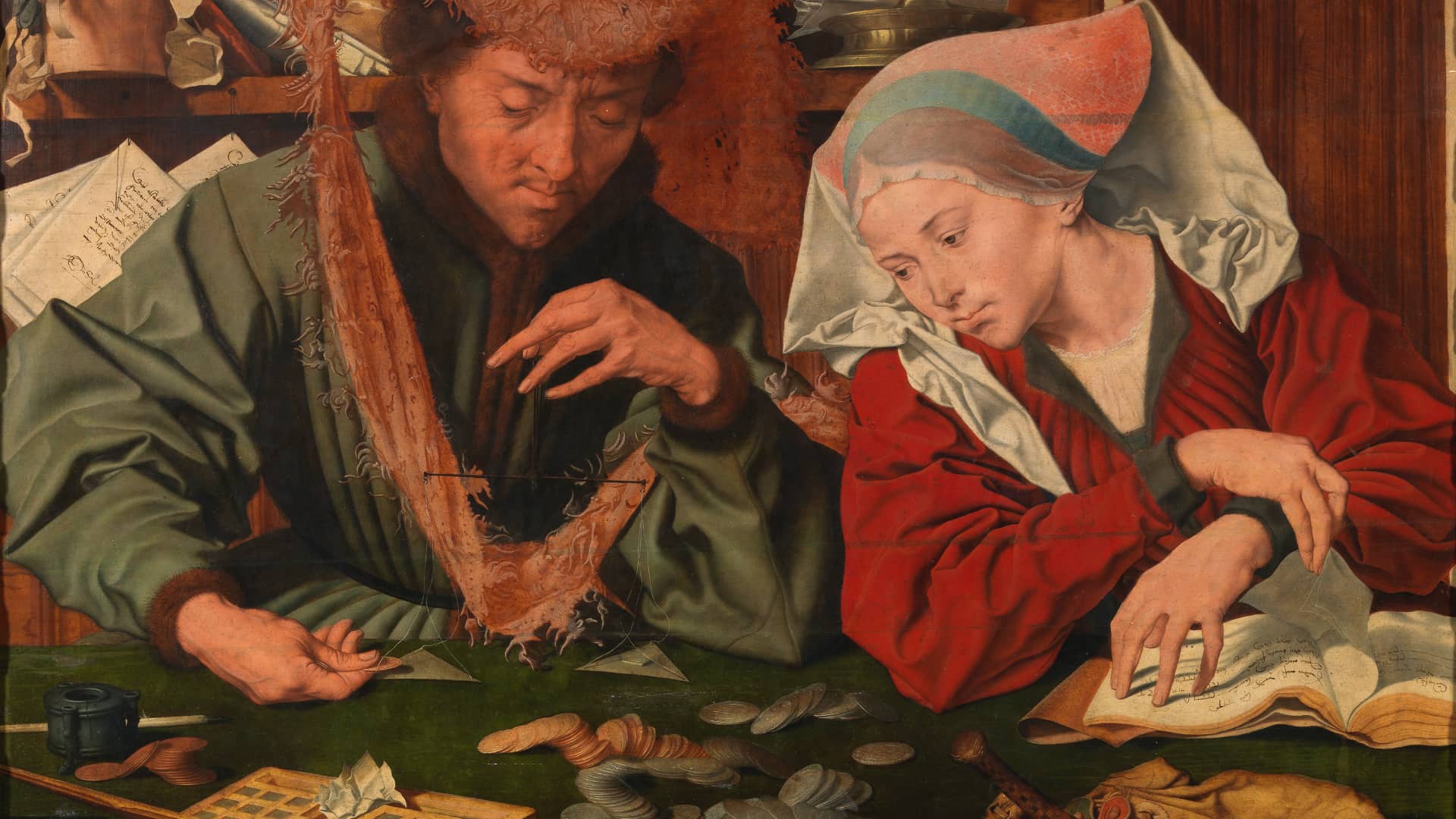
The English word "bank" comes from the Italian term "banco" (or "banca"), which in turn comes from the Frankish word "bank".
In Italian, “banco” originally meant a bench with a back, then a wooden bench seat, a shop counter in the 1300s, and a craftsman’s workbench in the 1500s. Finally, the term "counter where money was exchanged, collected and lent" came to mean the very institution offering these services.
Like almost everything, the origins of the banking system can be found in ancient history. Savings and loan services existed among the Sumerians of ancient Mesopotamia, where private individuals felt the need to entrust their wealth to priests, and also among the ancient Greeks.
Apart from this formal recognition, banking was an Italian invention.
Banks, which originally, in ancient times, were engaged in storing and storing wealth, later developed the function of promoting and stimulating the economy.
The modern banking industry was born and developed in Italy in the Middle Ages and in the early Renaissance, in the era of Italian communes, city-states and Signoria. Wealthy northern cities such as Florence, Siena, Milan, Venice, Genoa and Lucca became centers of trade with foreign countries. Genoa and Venice, two of Italy's four Marinares (the others being Pisa and Amalfi), controlled the import of textiles and spices from the East.
Italy was Europe's major economic power. International trade grew, but travel by land and sea to the rest of Europe and the East was very long and dangerous. The establishment of banks in major international trading centers was critical to facilitating trade.
That's why letters of credit were created, to save merchants from the danger of being robbed and killed while carrying large amounts of cash or valuable goods during their journeys, which could last for months.
Letters of credit were simply the first checks: bankers agreed to be guarantors of payments by signing a letter of credit (called a "letter of credit") that bound them pay sums of money to the holder of a letter of credit who was the seller of goods or services. The bank guaranteed payment in the event of the buyer's default and also acted on behalf of the buyer to ensure that the goods or services were supplied and that all agreed standards and quality of the goods were met by the supplier..
The use of letters of credit became a very important aspect of international trade and was a great success.
It was Florentine bankers who invented letters of credit and treasury bonds. Therefore, during the Renaissance, Florentine bankers added the function of guarantors of payments to their other existing functions of lenders, custodians of wealth, and money changers. This turned Florence into one of the richest and most powerful cities in the world.
At the beginning of the 15th century, there were about 80 banks operating in Florence, which lent money to kings, emperors and popes and had incomes higher than in England.
One of the oldest banks was a powerful bank founded by the Acciaioli family back in the 1200s, called the "Compagna di Ser Leone degli Acciaioli e de' suoi consorti", which had branches in the main trading cities of the world from Greece to Tunisia and Western Europe.
The bill of exchange (modern promissory note) also played an important role in reducing the movement of coined money. The coins were made of metal, but the letter of credit and the bill marked the beginning of the parallel circulation of means of payment.
The families and cities after which the banks took their names acquired high political authority. Among the wealthiest and most famous families of merchants and bankers were the Bardi, Peruzzi and Pazzi in Florence in the 14th and 15th centuries, who opened branches in many other parts of Europe.
The Medici Bank, founded by Giovanni di Bicci de' Medici in 1397, was what brought this great family to political power. Emigrating to Florence from the rural, fertile Sito River valley of Mugello in the 12th century, the Medici began as merchants in Florence's Old Market, became bankers a few decades later, and then rose to become lords of Florence. It was the wealth they acquired through banking that allowed them to become patrons of the most magnificent artistic movement the world has ever seen.
The city of Siena, where the Chigi family became one of the most important bankers, had a great commercial and financial tradition. It is home to the oldest existing bank in the world, Monte dei Paschi di Siena, which has been in continuous operation since 1472.
The Borromeo families of Milan and the Soranzo families of Venice were also prominent bankers..
In all these great trading cities, private banker families became rich and influential, even to the point of lending money to the great European feudal lords, monasteries, high church dignitaries and sovereigns. The latter made extensive use of loans to finance their wars. These activities were critical to the economic and political development of nation states. And wealth produced “through money” became the engine of social mobility, as in the case of the Medici.
The merchant banker was often the master of his city. With the political decline of many merchant bankers, their power became indirect: they financed kings and princes, and their economic fortunes became tied to the political fortunes of monarchs.
Sovereigns and counts, often unable to repay their loans, gave financiers monopoly rights in trade, exploitation of natural resources, or in services such as ports, customs, and tax collection. In other cases, they offered titles of nobility to bankers. Thus, for example, Cosimo de' Medici, the founder of the illustrious dynasty, was entrusted with the administration of Florence.
Later, the development of banking spread from northern Italy to the rest of Europe.
The Bank of Italy was created in 1893 as part of a general reorganization of the banks of issue of Italy.
In 1926, the essentially public position of the Bank received significant recognition, since it became the only institution authorized to issue banknotes. It was given powers of banking supervision, which were expanded and strengthened by the Banking Act 1936, which also formally recognized the Bank's status as an institution of public law. This remained the main Italian banking legislation until 1993, when the Consolidated Banking Law was adopted, which is still in force today.
The stabilization of the lira in 1947 was a decisive moment in the history of the Bank. The post-war surge in inflation was broken and the monetary conditions were created for the “economic miracle” of the 1950s. The 1948 Constitution enshrined the principle of “protection of savings.”
After the turmoil of the international monetary system and the lira in the 1970s, deflation in Italy was facilitated by stronger legal guarantees of central bank independence.. The restoration of currency stability and the beginning of an adjustment of public finances allowed Italy to meet the standards set by the Maastricht Treaty (1992) and to claim the role of the leading group of countries that adopted the euro as their currency in 1999. Euro banknotes and coins came into circulation in 2002.
The Bank of Italy from its creation to the adoption of the Banking Law of 1936.
The Banking Law of 1893 and the Giolitti era
The first period in the history of the new bank begins with its creation in 1893 and ends with the explicit declaration of its public character in 1936 year.
The Banking Law of 1893 (Law 449 of August 10, 1893), which established the Bank of Italy, was of fundamental importance. He redefined banknote circulation to be gold-based (more precisely: 40 percent of issued banknotes had to be covered by gold reserves) and established absolute restrictions on the issue of banknotes. This created the conditions for the restoration of the health of issuing banks. The transition to a single bank of issue began. And he established rules according to which the public interest took precedence over the profits of private shareholders (for example: the government's approval of the appointment of the head of the Bank of Italy - the director general - and changes in the discount rate).
During these years, Giuseppe Marchiori, director general from 1894 to 1900, constantly expanded the interests of private shareholders and reaffirmed the Bank's commitment to public goals. However, the Bank remained a private company issuing banknotes under a concession.
A very significant role in the development of the Bank was played by Bonaldo Stringer, who was appointed Director General in 1900. During the Giolitti era, the Bank was able to combine (given a favorable economic climate) financial and monetary stability with support for economic growth. In 1902 the old parity between the lira and gold was achieved; From then on, Italy behaved as if it were on the gold standard, but, learning from previous crises, did not officially declare currency convertibility. In 1906, the Bank of Italy carried out a fair conversion of previously existing irredeemable government bonds.. With this success, the Bank confirmed its role as a banker and therefore as an adviser to the government, in addition to its role as treasurer.
In parallel with the economic revival and industrialization, the credit system changed: during the crisis of 1893-94, when the two largest industrial credit banks failed, a new system emerged in which the bulk of the credit business began to be transferred from the three surviving banks of issue (Banca d'Italia, Banco di Napoli and Banco di Sicilia) to the newly founded large mixed banks (Banco di Roma, Banca Commerciale Italiana and Credito Italiano).
In 1907, the Bank of Italy effectively intervened to prevent a serious financial crisis, strengthening its role as lender of last resort and strengthening its reputation. To facilitate this work, the monetary circulation system was made more flexible by a law adopted at the end of the year. The need for supervision of the banking system began to be felt.
On the eve of the First World War, the Bank of Italy occupied a central position in the national financial system due to the importance of its credit for the economy, its actions to ensure financial stability, consolidation of the gold reserve and assistance to the Treasury in managing the public debt.
Post-war years and strengthening the public role of the Bank of Italy
During the First World War, the Bank provided the Treasury with enormous assistance: direct credit, assistance in organizing internal military loans and in the management of foreign financial transactions. The connection between the lira and gold was abolished, and a state monopoly on foreign currencies was established.
With the end of the war, problems of conversion for civilian use led to the collapse of many industrial sectors, and with them the credit institutions that financed them, to the extent that it led to major bank failures. The Bank of Italy, with government approval, intervened and carried out large-scale rescue operations. The currency monopoly was ended, but in the new circumstances a return to monetary normalization was impossible. Existing tools for controlling the money supply turned out to be completely ineffective.. There was domestic and international debate about how to return to a gold-based system. Italy took a conservative position in favor of the classical gold standard.
Amid mild inflation, the fascist government revalued the lira in 1926, thereby deflating the economy. As part of the plan for monetary stabilization and return to the gold standard (implemented by the Bank of Italy, despite Stringer's doubts about the strong risk of deflation), important reforms were carried out within three years. The Bank of Italy was given a monopoly on the issue of banknotes and tasked with operating the clearing houses, the central nodes of the modern payment system. A savings protection law was passed. New special obligations for banks were established, including minimum capital requirements. The Bank of Italy received new control powers, the core of which was supervision of the banking system. The reforms culminated in 1927-28 with the establishment of a new gold parity with respect to the lira and the restoration of convertibility into gold or convertible foreign currency (gold exchange standard), the introduction of an obligation to maintain gold or hard currency, the reservation of at least 40 percent of the money in circulation, and the renegotiation of relations with the Treasury.
As a result of these provisions, the Bank, abandoning its old role as a "bank of issue", became a true central bank and credit system controller. The fundamental character of the Bank as a public institution was strengthened. In 1928, a new Charter was approved, according to which the position of governor was created at the head of the Department (consisting of the governor, general director and deputy general director). Responsibility for setting the discount rate passed from the Executive Council to the Governor, who remained subject to government approval.
The Depression and the Azzolini Banking Act 1936
After Stringer's death in 1930, the post of Governor passed to Vincenzo Azzolini, who came from the Treasury.
At the height of the Great Depression, the devaluation of the pound sterling (in September 1931) and most other currencies was tantamount to a further revaluation of the lira.. The deflationary effect of Italian policies was intensified, with serious consequences for economic activity and the financial system. The state and the central bank saved large commercial banks from collapse, their assets inflated by even more depreciated stakes. The Bank of Italy found itself with extremely illiquid assets and was therefore unable to carry out operations. The response was the creation first of the Istituto Mobiliare Italiano (IMI) to provide medium- and long-term financing, and then of the Institute for Industrial Reconstruction (Istituto per la Ricostruzione Industriale - IRI), which acquired stakes in troubled banks and assumed a majority stake. share in the banks themselves. In the mid-1930s, the tensions that would lead to World War II were foreshadowed in the monetary sphere by the de facto end to the convertibility of the lira and the suspension of gold reserve requirements (which were never reinstated).
In the context of preparations for war (the invasion of Ethiopia began in 1935) and within the framework of the IRI, the Banking Law was developed. The first part of the Law, which is still in force, defined the Bank of Italy as an “institution of public law” and definitively assigned to it the function of issuing money (no longer just a concession); individual shareholdings were expropriated and capital was reserved for financial institutions of public importance; The bank was prohibited from discounting bills of exchange to non-banking organizations, which emphasized its function as banker to banks. The second part of the law (almost completely repealed in 1993) dealt with credit and financial supervision, completely revamping the credit system by separating banking and industry, and between short-term and long-term credit; it determined that banking is an activity of public interest; it concentrated supervision in the Inspectorate for the Protection of Savings and the Implementation of Credit (a newly created public body), headed by the governor and using the resources and staff of the Bank of Italy, but managed by a ministerial committee chaired by the Prime Minister..
Recognizing new trends in the economy and the challenges posed by a world undergoing violent changes, Governor Azzolini initiated the creation of a modern research service by hiring professional economists.
At the end of 1936, the long-awaited devaluation of the lira stimulated economic recovery and improved the balance of payments. At the same time, a simple ministerial decree lifted all restrictions on government borrowing from the Central Bank. The Bank's autonomy was at its lowest level.
From the 1950s to Maastricht
Reconstruction and development
For Italy, the 1950s were a time of sustained economic development in the context of monetary stability. The choice of international opening, which introduced a beneficial competitive stimulus into the economy, was reinforced by membership in the European Economic Community (1957) and the introduction (1958) of the convertibility of the lira into other currencies for non-residents (external convertibility).
The bank, headed by Donato Menichella (who succeeded Einaudi in 1948, when the latter became President of the Republic), sought to maintain long-term conditions for investment. He was directly interested in the problems of economic development and Southern Italy, never abandoning monetary control. Monetary policy instruments consisted of discount rates and central bank advances, which however remained stable for eight years from 1950 to 1958, and controls on credit, partly through moral suasion. Periodically, excess liquidity was eliminated through the issuance of bonds.
Treaty of Rome, March 25, 1957 Banking supervision was aimed primarily at preventing recurrence of episodes of asset illiquidity. An attempt was made to bring the structure of the banking system into line with industry: hence the encouragement of smaller banks, which were supposed to be more closely associated with small business (localism). In 1960, Guido Carli was appointed Governor of the Bank. In subsequent years, the country's economic structure gradually transformed. The role of the credit system was increasingly to redistribute resources between consumption and investment, and between the public and private sectors.. Since the mid-1960s, monetary policy has been oriented towards stabilizing securities prices in order to facilitate the placement of issues and thereby stimulate investment.
The Research Department has improved its analytical tools, primarily through the construction of the econometric model of the Bank of Italy and the implementation of "financial accounts".
With regard to the credit system, for the first time since the 1930s, bank mergers were encouraged with the aim of increasing technical efficiency, but definitely precluding a return to universal banking. The Central Credit Register was created.
The Turbulent Years
The 1960s ended in the midst of serious economic difficulties. The end of the Bretton Woods system (August 1971), the transition to floating exchange rates and the sharp rise in oil prices ushered in a long period during which two evils previously considered opposites coexisted: stagnation and inflation.
Inflation in Italy was noticeably higher than the average for other industrialized countries. Between 1973 and 1984, the rate was never below 10 percent. In addition to rising world prices, Italian inflation had serious internal causes: severe labor market tensions, increased government spending without a corresponding increase in revenues, and a lack of competition. The elimination of the discipline of fixed exchange rates also played an important role.
The policy of stabilizing securities prices became too onerous and was abandoned. To support investment while restraining domestic demand while curbing rising interest rates, administrative credit controls (bank lending ceilings and portfolio restrictions) and foreign exchange controls were introduced in 1973. Monetary policy in Italy, as in other industrialized countries, has tended to be restrictive and focused on explicitly stated medium-term aggregate targets (total domestic credit).
Buffy, Carli and Menichella. In 1975, Carli left the governorship and was replaced by Paolo Buffy, who had been director general since 1960.. During the currency crisis of 1976, the Bank made its lending ceiling more restrictive and tightened exchange controls to impose restrictive measures more effectively.
The Bank repeatedly emphasized the costs and limitations of this set of policy instruments. Actions were initiated to expand the ability to conduct monetary policy through the market, especially through the purchase and sale of securities (open market operations). To this end, the first steps were taken in 1975 to create a true money market, with procedural changes in the issuance of treasury bills and reform of the reserve requirement.
In December 1978, Italy joined the European Monetary System, agreeing to a wide range of fluctuations of the lira of 6 percent above or below the central rate, while other member countries had a narrower range of plus or minus 2.25 percent, as inflationary Italy's differential, although narrower, was still significant.
Supervisory measures were aimed at encouraging the strengthening of banks' capital, improving their internal laws and organization, and expanding opportunities for competition. In the second half of the decade, on-site inspections became more extensive and analytical methods were improved. To meet the growing need for international supervisory cooperation, the Basel Accord was signed in 1983.
In 1979, the leadership of the Bank of Italy was overthrown by a judicial initiative concerning banking supervision. Although the actions subsequently turned out to be completely unfounded, Governor Buffy was charged and Deputy General Manager Mario Sarcinelli was arrested. The events became a difficult test for the Bank. Thanks to the general demonstration of solidarity from qualified opinion, both Italian and international, as well as the independence and prestige of the Bank and its employees, the institution withstood the crisis.
Paolo Buffi decided to retire in October 1979 and was replaced by Carlo Azeglio Ciampi, who was appointed Director General in 1978 after a long career with the Bank..
Taming Inflation and Maastricht
The second oil crisis of 1979-80 again caused prices to rise, but three factors contributed to the process of falling inflation and industrial restructuring. In 1979, the European Monetary System came into force, accompanied by tight monetary policy, which strengthened the real exchange rate of the lira. In 1981, the Bank of Italy received full autonomy in deciding on the purchase of treasury bills that were not accepted by brokers at auctions (the so-called “divorce”).
The decline in wages was caused by rising unemployment and weakening wage indexation. Real interest rates returned to positive values.
The campaign to improve the effectiveness of monetary control through market instruments, which began in the second half of the 1970s, continued. Finally, with the introduction of an efficient auction system for the issuance of Treasury bills and a functioning interbank deposit market, a true money market emerged. In 1987, the inflation rate reached a low of 4.7 percent, and in 1990 the lira entered the EMU “narrow band.” However, in 1990, inflation rose again to 6.5 percent, caused, among other things, by unresolved structural problems. The current account deficit has become alarming and investment has declined. That is, the recovery of the Italian economy was still partial and fragile.
The Single European Act, adopted in February 1986, defined the stages of the process of eliminating the remaining trade barriers dividing the EU's national markets. Six years later, in February 1992, the Maastricht Treaty was signed, laying the foundation for the single currency and the European System of Central Banks. In 1990, the completion of liberalization brought an end to exchange controls that had been in place in Italy in one form or another since 1934. This contributed to the international integration of the Italian economy and financial system.
In the 1980s, the Bank of Italy's supervision was extended to non-bank intermediaries, although only in relation to matters detrimental to the stability of the financial system.. The Bank began a transition from “structural” supervision (which used powers to shape the structure of the system) to “prudential” supervision, based primarily on general rules of conduct. In 1990, three fundamental laws were adopted: one on commercial banks and groups (the so-called Amato-Carli law), one on securities and one on the protection of competition. The first established a level playing field for banking operators by defining the joint stock company as the general model of banking business, laid the foundation for the privatization of banks and regulated credit groups. The second regulates securities intermediaries and stock markets. The third introduced antitrust principles and tools.
During the same years, the Bank of Italy set the goal of improving the integrity and efficiency of payment services. The national clearing system and bank account transactions at the Bank of Italy were fully computerized. The on-screen market for interbank deposits (Mercato Interbancario dei Depositi - MID) has been launched.
In Europe
The Maastricht Treaty established strict convergence parameters for countries intending to join the Economic and Monetary Union. The calendar for monetary union was set: the first stage of economic and institutional convergence; the second stage of regulatory and procedural harmonization to prepare for the implementation of a common monetary policy, providing for the creation of the European Monetary Institute, the predecessor of the European Central Bank, in 1994; and a third phase, starting in 1999, for the actual introduction of the single currency.
In the summer of 1992, different economic policy positions of the United States and Germany, combined with uncertainty regarding the ratification of the Maastricht Treaty, triggered a currency crisis that affected many countries. The lira depreciated by about 20 percent.
In 1993, Antonio Fazio, deputy director-general, took over as governor when Carlo Azeglio Ciampi was appointed prime minister (he later became president of the republic).
In Italy, the crisis caused a violent reaction. First, public finances were put in order by significantly cutting spending and, above all, increasing revenues.. In the summer of 1994, monetary tightening ushered in a period of tightness. In 1995, when another currency crisis occurred, the discount rate reached 9 percent. Decisive actions by the Bank of Italy in these years have helped lower inflation expectations. Since price increases were limited, monetary conditions were eased in 1996. Renewed confidence, both at home and abroad, allowed long-term interest rates to fall and led to a sharp reduction in interest payments on government debt; Thus, monetary policy made a significant contribution to the adjustment of public finances. Thanks to these efforts, Italy was among the first wave of countries to adopt the single European currency.
The 1990s also saw a process of institutional convergence. In accordance with the requirements of the Maastricht Treaty, the independence of central banks was strengthened. In Italy this was done in several stages. At the beginning of 1992, the Bank of Italy received fully independent powers to set official interest rates. In the fall, the law prohibited the state from financing itself through overdrafts of the current account at the Bank. The Bank of Italy has not participated in auctions of government securities since 1994.
The transposition of the Second Banking Directive (1992) into Italian law established fundamental rules for the financial sector. The banking specialization that characterized the credit system created in 1936 was abolished, and universal banks became possible. A number of measures taken over the years, such as measures to encourage savers to move towards investments in shares, supplementary pension plans and assets under management, have significantly reformed the regulatory framework for banking and finance. All this was enshrined in the Consolidated Banking Law of 1993 (Testo unico Bancario) and the Consolidated Finance Law of 1998 (Testo unico dell'intermediazione finanziaria). The 1993 law also made the Bank of Italy responsible for the smooth operation of the payment system.
Law 262 of December 28, 2005, on the protection of savings and the regulation of financial markets, also changed the organizational and institutional structure of the Bank of Italy. Governor Antonio Fazio resigned that same month..
On May 31, 2006, Mario Draghi, appointed Governor on December 29, 2005, presented his first closing speech to the General Meeting of Shareholders. The Governor noted the complexity of the area in which every modern central bank must operate. The field of activity of Eurosystem central banks has become even more extensive. It ranges from the establishment of general monetary policy to the operations of payment systems. Solutions and institutional arrangements must be tailored to the needs of a developed but diversified economic zone. The Bank of Italy also operates in a broader international context, covering supervisory guidelines, economic analysis and initiatives to protect financial stability.
According to italytravelideas.com

You May Also Like
Liechtenstein private bank begins trading cryptocurrency
Bank Frick will be the first regulated bank to offer not only direct investment in cryptocurrency, but also its cold storage. The bank announced this in its press release dated February 28.
U.S. Bank launches cryptocurrency storage services
US Bank, one of the five largest US banks, is launching a cryptocurrency asset custody service for investment managers.
