
In our reviews, we often mention the stochastic indicator, the signals of which guide us when trading cryptocurrency. In our review, we will briefly talk about some of the technical features and explain some of its signals.
Stochastic Oscillator - (English Stochastic Oscillator) is a technical analysis indicator that shows the ratio of the closing price of the current period to the difference between the maximum and minimum price value for a given period, expressed as a percentage.
That is, if we use stochastic on a four-hour time frame with parameters 14,3,1 and its value is 20%, this means that the closing price of a four-hour candle is 20% of the difference between the maximum and minimum price that was during the period of formation of the 14 previous candles. (We’ll look at other numbers “3” and “1” below)
The indicator was first described by financier and technical analyst George Lane. His theory was based on a pattern in which the closing price of a candle is usually fixed closer to the maximum of a given period in an uptrend or closer to the minimum of the period in a downtrend. If prices are fixed at a sufficient distance from the extremes of the period, then there is no clearly defined trend in the market.
The indicator consists of two curves, one of which is usually designated %K and is called the fast main line, and the second is designated %D and is called the slow additional curve. Often the main line is depicted as a solid line, and the additional one as a dotted line, and sometimes they are simply highlighted in different colors.
To build the Main Line %K, the following formula is used:
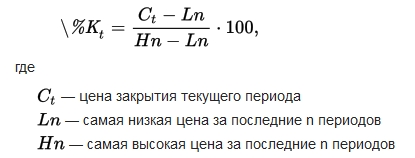

And the Additional Line %D is moving average %K with a specified period. Its function is to smooth the values of the Main Line %K.
\%D = SMA (%K),
where
SMA is a simple moving average.
In the stochastic parameters, the second digit in brackets: “3” - indicates the smoothing period %D (for averaging %K).
When working with an oscillator, it is customary to highlight zones overbought and oversold. Typically they are set at 20% of the upper and lower stochastic values. According to the theory of J. Lane, a reliable stochastic signal for a price decrease will be formed when the fast line and the slow line cross (from top to bottom), only at the moment of leaving the overbought zone in the neutral zone.. And the price increase will be shown by the upward intersection of %K and %D at the moment of leaving the oversold zone.
At other times, the indicator may give false signals.
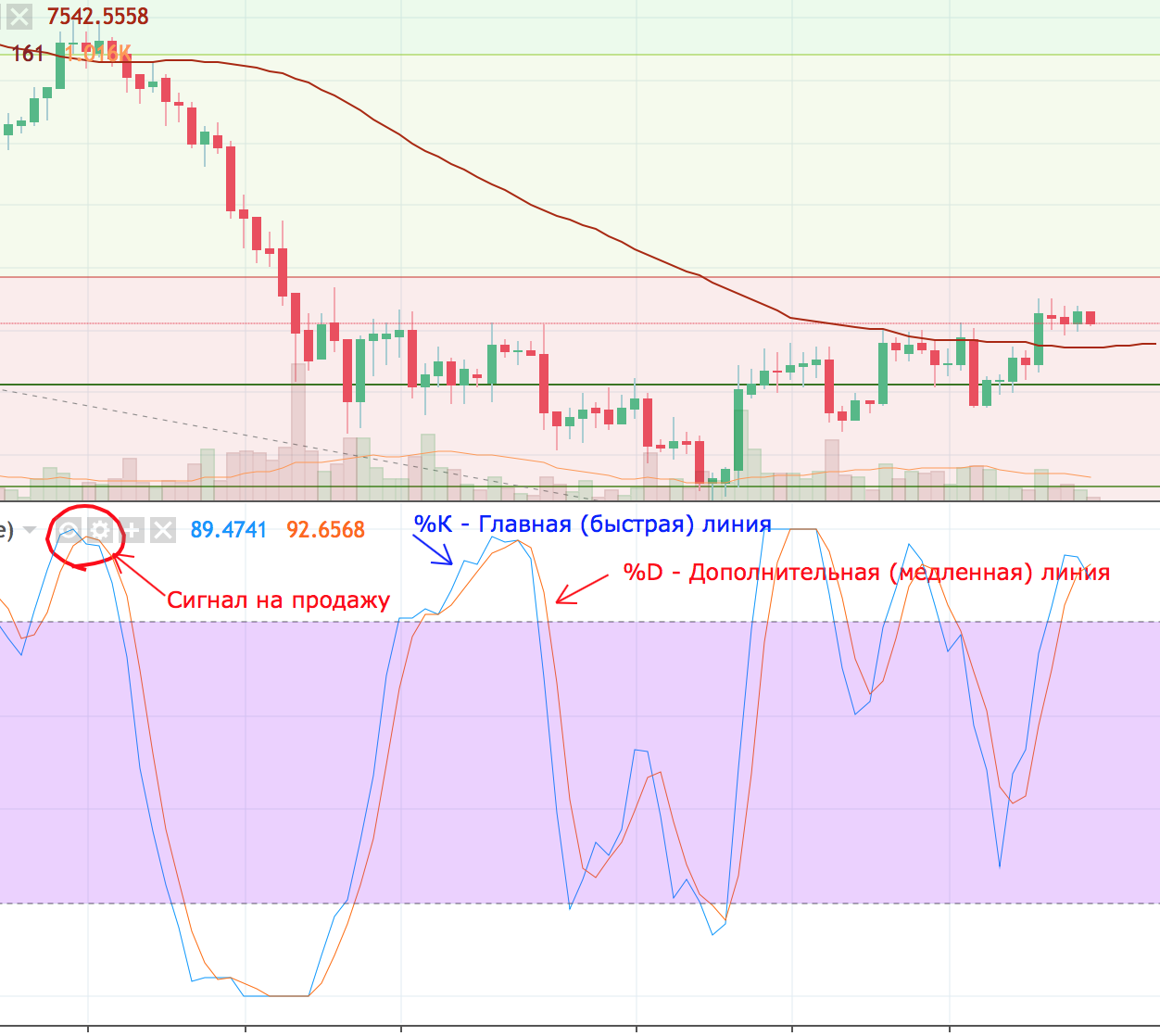
In order to track false signals, the stochastic indicator is used in conjunction with other indicators, for example MACD.
MACD (Moving Average) Convergence/Divergence (moving average convergence/divergence) is a technical indicator developed by Gerald Appel, used in technical analysis to assess the strength of a trend and predict price fluctuations.
Using two moving averages with different periods, the indicator helps determine how strong the current trend in the market is. If a trend change is expected, then the indicator curves intersect, and if the trend develops, then the curves diverge. If the MACD and stochastic signals coincide, then the probability of a false signal is minimal. We will return to this indicator in more detail in our next review.
Divergence and Convergence are considered reliable stochastic signals for a trend change. The essence of these signals can be explained in a simple diagram.
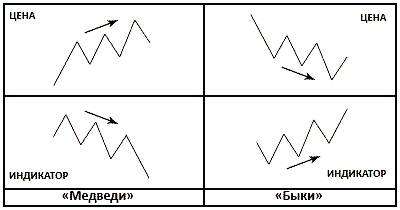
If the price chart shows rising highs (bullish trend), and the stochastic readings record decreasing highs, this means that the bullish trend will soon change to bearish. This is a fairly strong signal for an upcoming price fall, which is called “Divirgence” (divergence), i.e. arrows connecting the maximums diverge.
Convergence is the situation when the arrows connecting the minimums of the price chart and the minimums of the stochastic converge. This suggests that the bearish trend will soon turn into an upward one. These signals are almost never false, and are often found in highly volatile markets. Currently, the crypto market has just such a feature in price dynamics.
I would like to draw attention to the use of stochastics in crypto trading. Due to the high volatility of the market and the large amount of “noise”, it is recommended to use the indicator on larger time frames: four hourly, eight hourly and daily charts. Then there are fewer false signals in the stochastic readings..
In addition, for certain assets it is worth carefully selecting the periods of moving averages and the averaging period. This can be achieved by first observing the dynamics of the selected asset. In order to achieve clarity, it is advisable to select the parameter values by experimenting with them in practice.
Stochastic has proven itself very well in areas where a pronounced sideways price movement is replaced by an impulse. And in the overbought and oversold zone, it is not very informative.
Despite many limitations and disadvantages, the use of stochastics in crypto trading is quite effective. Its reliability increases when used in combination with other indicators. We would recommend using this indicator for trading, taking into account all of its listed features.

You May Also Like
Forks, hard forks, altcoins... Don't get confused!
More and more people are immersing themselves in the world of cryptocurrency. The world is quite complex to understand without technical training and knowledge of specific terms. To assess the situation on the market, manage investments correctly, and navigate the flow of news and ratings of cryptocurrencies, today we get acquainted with the term fork.
Fibonacci levels
In this review I will try to talk about Fibonacci levels in simple language.
